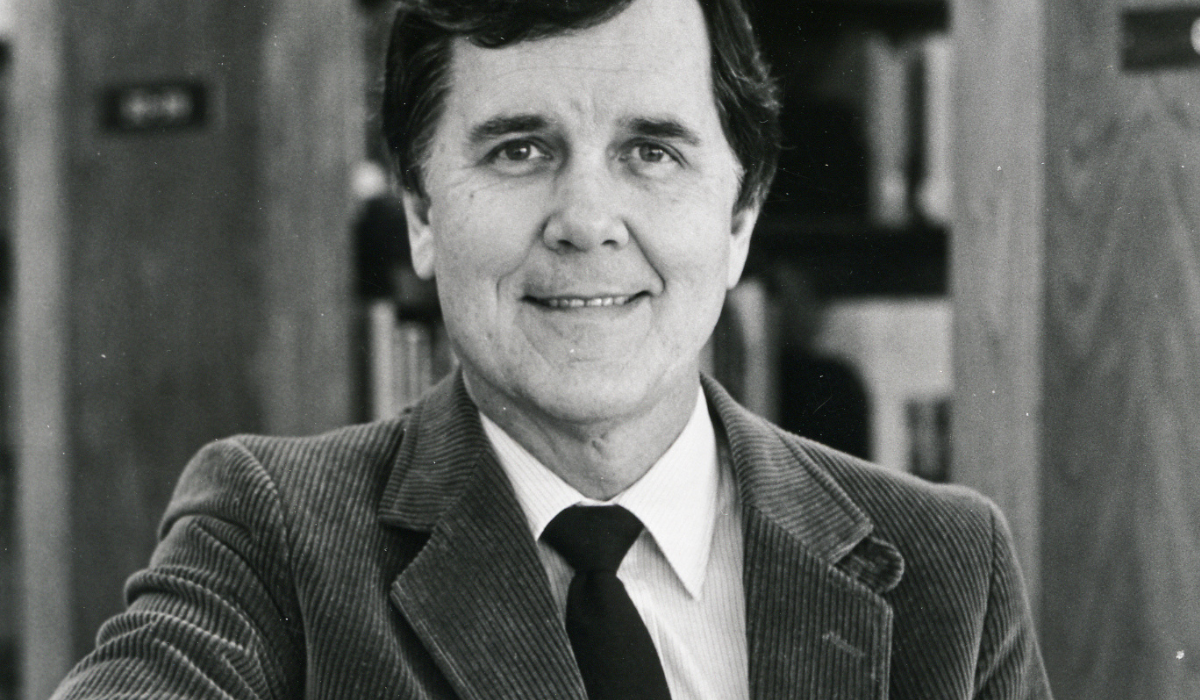
Dawn McCollough ’99 said when she arrived at the JBU campus and met Mike Flynn in person, she knew that JBU was where she was destined to be.
“My first hero was Walter Cronkite, who reported the news without editorial or bias. My second hero was Mike Flynn, cut from the same cloth, but local and handsome,” said McCollough, who grew up in Northwest Oklahoma listening to Tulsa’s KOTV Channel 6 news.
After graduating with a JBU broadcasting degree in 1999, she spent more than 20 years working in radio in Northwest Arkansas at JBU’s radio station 101.1 KLRC as well as KEZA-FM 107.9 in Fayetteville. McCollough was the voice of the KLRC day sponsors for more than 25 years.
She lauds Flynn as a guiding light during her college career, a professional sounding board and a personal hero throughout her life. McCollough’s not alone.
JBU broadcasting alumni across the country have been eager to pay tribute to Mike Flynn since they received word of his passing in January at the age of 91. As a news anchor, a nationally syndicated radio show host of “The Folk Sampler” for more than 40 years, a JBU broadcasting and communications professor, and one of the founders of KLRC, Flynn’s legacy runs deep at John Brown University but also extends around the globe.
The Heart of a Teacher
After serving as a news anchor in Tulsa, Oklahoma, Flynn settled into life in Siloam Springs in 1978 as a JBU professor of broadcasting and communications. For the next four decades, he taught and mentored JBU broadcasting students. One of those students from his early days was James (Jim) Hanemaayer ’78. As a student, Hanemaayer became the station manager of KJBU-FM, the student-run, campus radio station at the time, under the oversight
of Flynn.
Hanemaayer went on to have a long and extremely successful career in broadcasting and voice acting. He spent 18 years as a European special journalist for NBC radio, based primarily from Moscow. He has recorded commercials for national campaigns for Delta Airlines and Olive Garden, and now at age 70, he narrates 40 to 50 documentaries and 25 to 30 audiobooks annually. He recently completed narrating a documentary on the life of actor Anthony Hopkins, and he credits his production classes at JBU in preparing him for such opportunities.
“Mike Flynn had been a television newscaster when he first came to JBU, and he shared many insights with his students about how the news business works,” Hanemaayer said.
Under Flynn’s leadership, the JBU broadcasting department served as a springboard, launching hundreds of students like Hanemaayer out into the influential world of broadcasting, journalism and communications. Gary Warner, JBU journalism professor from 1993-2010, worked with Flynn in the communications division. Warner and Flynn taught alongside each other for many years, training and mentoring students in communications.
“Mike was a dear friend and colleague for more than a decade before he retired,” Warner said. “He was instrumental in hiring me. On my first visit to JBU, he fed me a veggie burger during lunch at his house. So, I went back home to Kansas City, waited a year, and then came back and took the job after it was promised that only real hamburgers would be served.”
KLRC
When Flynn started KLRC in 1983, it was a 100-watt station with a signal that hardly reached beyond the JBU campus. But Flynn knew it would be the perfect training ground for JBU broadcasting students. The station was named KLRC for the campus Learning Resource Center where it was housed.
No one could have imagined that the little 100-watt campus radio station would eventually move to its own building in downtown Siloam Springs and grow into an award-winning, 100,000-watt signal station with a huge impact on Northwest Arkansas, the River Valley, Eastern Oklahoma and Southwest Missouri.
KLRC General Manager Sean Sawatzky ’96 has played a key role in taking what Flynn started and growing it into the top radio station in the Northwest Arkansas market, across all radio formats.
The JBU broadcasting department is what brought Sawatzky to JBU and to KLRC.
“Broadcasting is literally the reason I came to JBU,” Sawatzky said. “I’m one of those weird people who always knew what I wanted to do. When I turned 16 and could drive, I got my first radio job. I knew I wanted to attend a Christian college that had a strong broadcasting department, and JBU was one of two schools I knew of.”
After working a couple of summers as a student at KLRC, Sawatzky was a senior when Professor Rick Sparks was going on sabbatical. Flynn hired Sawatzky the same week he graduated to work full time at KLRC to fill in for Sparks. At the time, he was the very first full-time employee of the radio station.
“My wife, Kim, was a year behind me at JBU, and we thought, ‘We’ll do this for a year,’” Sawatzky said. “It went from a mindset of ‘Let’s do this for a year,’ to ‘I think we are supposed to be here.’”
Sawatzky’s one year turned into three decades. This year, he celebrates 30 years with KLRC.
He said that during his early days at KLRC, he learned invaluable leadership lessons from Flynn.
In 1996, the station needed to raise more money to expand its reach and its ministry. Sawatzky had an idea to change their fundraising strategy to increase donor engagement, so he took it to Flynn.
“Mike told me, ‘If it fails miserably, I’ll tell everybody it was my idea. If it’s a success, I’ll tell everybody it was your idea,’” Sawatzky recalled. “Nobody does that. I realized even at the time, ‘I’m never going to forget this. I want to be that kind of leader.’”
The fundraising efforts were a huge success. The previous year, KLRC had raised $32,000. With the new strategy, they raised a little over $100,000. These efforts continue today with fundraisers held in March and October each year. The most recent fall event raised $690,000, and last spring brought in $967,000.
KLRC reaches roughly 80,000 listeners a week and is No. 1 in the Northwest Arkansas market among more than 30 radio stations serving it.
In April, KLRC acquired its eighth radio signal (94.5 FM in Fort Smith) with the aim of being on the air by late summer.
In 2025, KLRC made a big move for Real FM, an online radio station and mobile app it started in 2018, launching it as a full-fledged broadcast station at 100.3 that reaches NWA and Southwest Missouri. Real FM targets young adults and young families, with positive, modern pop, hip-hop and dance music through a mix of Christian and mainstream music.
Sawatzky says that the real success of KLRC is the impact it’s had on the community. With an employee team of 14 plus student workers and part-time announcers, KLRC is now able to serve the community more than ever.
Some of the more impactful community projects from the last year include: an air conditioner giveaway (40 portable AC units to area families in need), Single Parent Saturday (free oil changes given to 50 local single parents) and Three Christmas Wishes (community comes together to make Christmas possible for three local families). This summer, KLRC introduced Summer of Service, a campaign that highlights volunteer opportunities available in the community.
“Community service is the real heartbeat of what we do,” Sawatzky said. “We love to use this platform God has given us to unite nonprofits and churches who want to make a difference. We are here to serve and impact the community. We are able to do that in ways we could not have dreamt of back when we started.”
Sawatzky said that even though JBU no longer has a broadcasting major, KLRC still offers a broadcasting practicum, summer internships and a work-study program.
This article is from the summer 2026 edition of the Brown Bulletin. Access the full issue.