
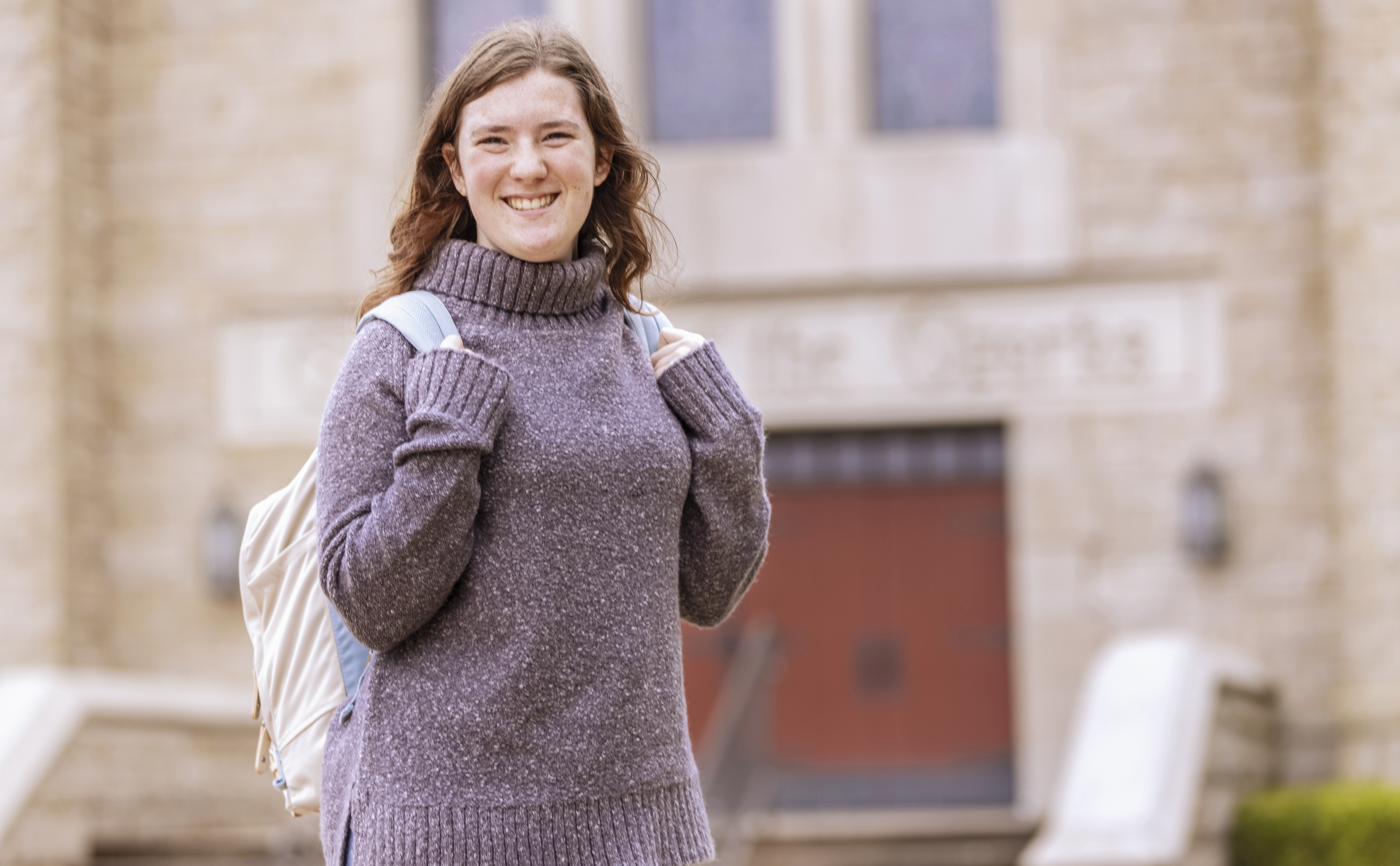
Anna Marie Ward finds her calling in equipping teachers and helping children.
Spend five weeks working with inner-city boys at a summer camp, and you just might find your life’s passion. Elementary education major Anna Marie Ward ’25 didn’t know then what her honors senior capstone project would be, but she knew she wanted a way to help people who work with children facing trauma.
While most counselors were only with their group for one week, Ward meshed so well with her group, that she stayed with them for five weeks. But as an untrained teenager, she felt ill-equipped to support them.
Ward found herself crying about the boys one day, not because the job was hard, but because she didn’t know what she could do for them.
“I was crying because I realized I can’t help these kids, and I want to help them, and I had no idea how to help them,” she said.
Ward said her interest in trauma-informed teaching was further piqued during her sophomore year at JBU when she sat in on a seminar with Brenda Morton, Ed.D., a specialist in trauma education and professor at the University of Mary Hardin-Baylor.
Afterward, Ward wondered why she wasn’t seeing more of the trauma-informed teaching practices in the local classrooms she was observing, and her exploration into trauma-informed education began.
“One of the things I realized was there was a divorce, almost, of head, heart and hand, in trauma-informed education,” Ward said. “The researchers have the head, and they have the heart, but they’re not connected to the hands. The teachers have the heart, and they have the hands because they’re working with the kids, but they don’t have the head — they don’t have the research.”
Ward wanted to address the disconnect she saw by making the research and practices of trauma-informed education more accessible to teachers to better equip them for the students they would face.
During her internship, Ward observed teachers using various trauma-informed techniques and interviewed seven teachers and counselors to create her trauma-informed practices manual.
The manual includes six practices for teachers to implement, as well as a quote from one of the teachers or counselors she interviewed at the start of each section.
“She has a heart for special education and students with disabilities and making an inclusive environment for them,” said Hollie Gumm, Ph.D., department chair for teacher education. “What stands out to me is that she’s one of those teachers that isn’t just about the instruction itself. She wants the classroom to be a safe place for students to learn.”
Ward graduated in May with a Bachelor of Science in elementary education and plans to put her trauma-informed practices to use in Hungary, where she will be teaching at an international Christian school in the fall.
Many of the students there are directly impacted by the war in Ukraine, and Ward said one of her goals is to create a space for them to share the hardships they’re facing.
“Yes, we’re learning academics, because you see the glory of God in math, reading and science, but you also see the glory of God in unpacking individual stories, because our God wrote every single person’s individual story,” Ward said. “And so to say, ‘your story has value and your story has meaning, and your story has power, and there’s a better story that’s writing it all,’ is huge for these kids.”