
Selma trip brings students face-to-face with civil rights legacy
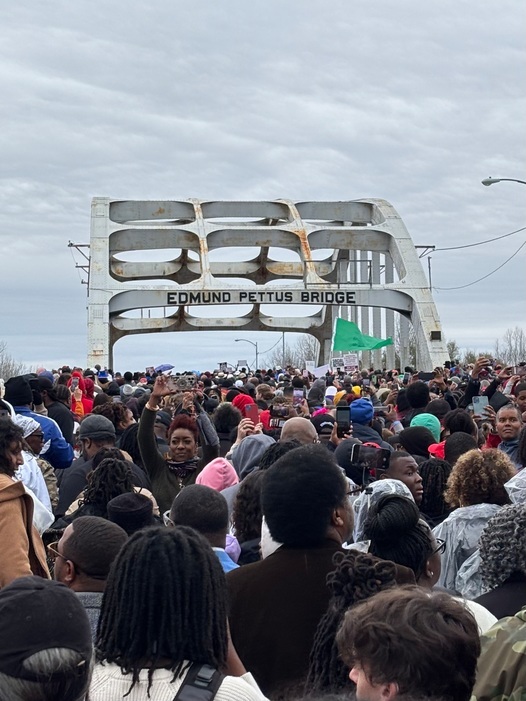
Over spring break, a group of JBU students and faculty walked across the Edmund Pettus Bridge in Selma, Alabama, visited the Legacy Museum in Montgomery and reflected at the 16th Street Baptist Church in Birmingham — landmarks that shaped the Civil Rights Movement and continue to impact people today.
The five-day trip was part of “Visiting History: A Trip to Selma,” a spring intercultural engagement colloquium class led by Chief Intercultural Engagement Officer Ted Song, Ph.D., and University Chaplain Keith Jagger, Ph.D. Designed to explore the Civil Rights Movement through both historical and Christian perspectives, the course concluded with a trip to Alabama during the 60th anniversary of Bloody Sunday and the Selma to Montgomery march.
Throughout the week, students encountered the weight of America’s history in deeply personal ways.
At the Legacy Museum, sophomore Juliana Fanning, who plans to study law, was struck by the stories of the wrongfully incarcerated. She said the trip reminded her of the Christian call to promote equality and dignity for all people.
“It pained me to see how broken our legal and justice systems are,” Fanning said. “Being able to pick up a phone and watch someone tell their story on the other end was very moving.”
The group also visited sites of racial violence and resistance, including the National Memorial for Peace and Justice and the 16th Street Baptist Church, where four young girls were killed in a 1963 bombing.
At the church memorial, Zipporah Jones ’25 experienced one of the most moving moments of the trip. The group met a man whose grandfather helped rebuild the church after the attack.
“They were part of a great legacy, and this was a beautiful moment for them,” she said. “It was a gift and an honor to be welcomed into this moment with them.”
Jones, who said she was filled with grief and celebration throughout the trip, left with questions still stirring in her heart — “What role do I have to play in the restoration story? How do I help set the captives free?”
For junior Maya McKinnie, the trip clarified the person she wants to be.
This whole experience taught me to be very conscious of my beliefs about others,” she said. “I want to always be able to say without a doubt that I made the lonely feel seen, that I sought after those who were struggling and that I always stood up for the oppressed.”
Though the trip was rooted in history, students returned with a clearer sense of how to carry what they’d learned into the future — whether in the classroom, in their careers or in how they live out their faith.
During the march, Ashley Phelan ’25 was interviewed by NPR. She said the experience reminded her of the need for compassion, especially in a divided world — “I think we need unity right now,” Phelan said. “And no matter what happens politically, we need to remember we’re all on this earth together — that we’re all God’s children.”